
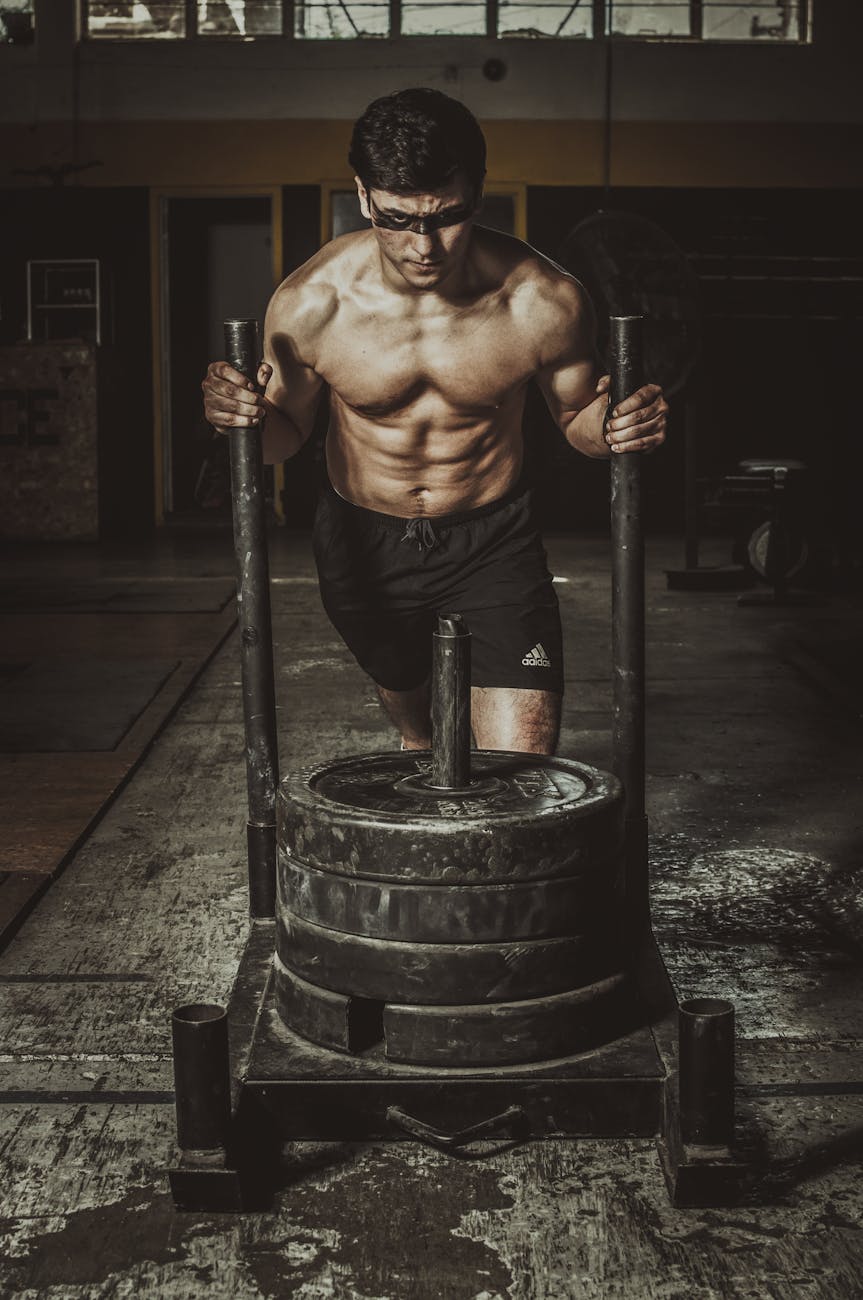
I think at one point in time or another just about everyone can benefit from including some Strongman work in their training. This is not to say that every person should be picking up Atlas Stones or towing an airplane like you see on World’s Strongest Man (although that would be cool). It’s simply to say that the movements in Strongman, in combination with the awkwardness/unfamiliarity of the objects, will provide a quality training stimulus to just about anyone.
First and foremost, I am not an expert on Strongman. I don’t compete in Strongman, and I don’t train at a Strongman gym. This article is not about the technicalities involved in the sport or anything like that – I’m just going to argue why I think you should include some Strongman work in your weekly training.
When I was in grad school I was introduced to Strongman training with a group of the older strength coaches there – one of which was a good friend of mine, Nick O’Brien, who made a presentation during COVID quarantine on adapting Strongman training to the athletic performance setting (see link here: Strongman Presentation). I think everyone should check out his presentation, as it’s basically how I view Strongman for the “non-Strongman competitor”. With that being said, let’s dive in a bit further.
Training Movement Patterns
Strength coaches love to talk about movement patterns. What better place to find movement patterns than Strongman? In its most basic form, Strongman revolves around: Pulling, Pressing, Squatting, and Carrying. Every competition you ever go to is going to include these patterns…which look exactly like every movement pattern that every strength coach is going to tell you to work on to improve athletic performance. The big difference with Strongman is that you are doing these patterns in a variety of ways and with a variety of implements. Similar to the concept of “constant variation to avoid accommodation” that Westside implements, Strongman works in the same vein: you can carry farmer handles for time, distance, or weight or you can carry an Atlas Stone for time, distance, or weight. You can pull on a fat bar from varying heights, or you can pull that same fat bar for reps in a given time frame. The point is that you are training movement patterns at different angles and getting strong in all those movements and all those angles.
Beginner tip: Invest in a heavy sandbag (I have zero affiliation with this company and get zero compensation from this, but I got mine from here: https://www.getrxd.com/colossus-sandbags.html – you can get them from anywhere).
You can:
-Squat the sandbag for reps or time
-Carry the sandbag for distance or time
-Lunge with the sandbag
-Pick it up and load it onto a stand
-Pick it up and throw it
You get the point. In my opinion, if there’s one piece of equipment you should get to include Strongman work into your own training it’s a sandbag. Your glutes, hamstrings, quads, core, forearms, lungs, and heart will thank you later.
Challenging
This point should be incredibly self-explanatory: Strongman training is challenging – mentally and physically. If I tell you to pick up a 250 lb. sandbag and walk as far as you can, 1) it’s going to be very demanding on your body and 2) you’re going to want to quit…a lot. This is part of the reason why Strongman training is so rewarding – completing the challenge of the training. Overcoming doubt and uncertainty can teach you a lot about yourself.
Beginner tip: Take the sandbag you bought from the first point of this article and carry it as far as you can. Whenever you drop it, rest 2:00 then do it again. Do 3-5 total rounds. This will be a great place to start with challenging Strongman work.
Fun
An oft-overlooked part of training is the fun aspect. Of course training is supposed to be hard. There are times when it becomes mundane (and that’s okay…it’s supposed to be like that sometimes). However, a fresh new challenge or perspective can take your training to new heights. I am not saying to replace all the boring, repetitive training completely – this is an absolutely necessary part of the process for improvement over the long-term. You need to learn consistency and discipline with your approach to regular training. However, the fun or “cool” factor of Strongman work may allow people a fresh perspective mentally, which will ultimately allow for more output physically.
Beginner tip: Put your car in neutral and have someone in the driver’s seat to steer. Get behind the car and push it (please do this on a dead-end road or in a parking lot…unlike myself, I’m assuming you’re smart enough to realize not to push a car on a busy road, but just in case…). Push it as far as you can. You’re getting a great training stimulus and conditioning stimulus. And of course…it’s cool and fun.
Potential Missing Link
I had a conversation recently with someone I view as a close friend in the field. He was telling me that he had started to incorporate more Strongman work into his training during a speed endurance block of his training. He said he felt physically stronger when running and was able to maintain his shapes better (and longer). I genuinely believe that Strongman work is a missing link between traditional barbell work and field-sport work. You need to have requisite strength levels in the traditional lifts (HERE for reference). However, once you do, mixing in Strongman work can help you with athleticism and transfer to the field (again this is purely anecdotal based on my own experience and the experience of a few others that I am close with). With Strongman training, there is the “brute strength” aspect of manipulating an odd object to do what you want it to do. Additionally, you are training your muscles at varying lengths and tensions while trying to manipulate said object. You don’t necessarily have to think about “engaging your core” while doing a Stone pick – you’re either going to “engage” or you’re not going to be able to move the Stone.
Beginner Tip:
Set cones 60 feet apart. At the beginning line, have three different objects (for instance a sled, a sandbag, and a heavy kettlebell). Push the sled from the start to the end of the 60 feet, run back, pick up the sandbag and carry it to the end. Run back again and pick up the kettlebell between your legs. Walk (run) with it to the end (“Duck Walk”). This is one round. Rest 3:00, and then repeat this for 3-5 rounds as a finisher at the end of a training session.
Closing Thoughts
This article is really only touching the surface of why I believe in Strongman work for (just about) everyone. Again, if you want a more thorough explanation with more examples and monthly progressions, I would highly recommend checking out Nick’s presentation from earlier in the article, or just reach out to him (or me) about the subject. At certain phases of my training I will dedicate every Saturday of the block to a “Strongman” training session. I believe that this has helped to keep me mobile, strong, and athletic.
 All Star Performance
Leave a comment