
I recently bought a rubber training log (aka a knock-off ViPR) to train in the backyard with. A good friend named Jeff Dolan introduced me to the ViPR a couple years ago, and I have used it as an important tool in my training ever since. He led to the “ViPR Pro” training course, and a lot of what was talked about made sense to me.
The log is primarily used for “Loaded 3D Movement Training”. This essentially means a few things:
-Moving an external mass/load in multi-directional ways
-Task specific training vs. muscle specific training
-Whole body integration
-Heavily dominated with rotational and frontal plane movements (as opposed to traditional training, which is sagittal-dominant)
In the course, it is explained that in the past, “farm kids” (and especially hockey playing farm kids) were really strong. They are strong on their feet and hard to knock off the puck in odd positions. This made a lot of sense to me – I was always a fairly strong skater and although I wasn’t raised on a farm, I shoveled a lot of snow in my younger years. I believe the combination of playing hockey and growing up shoveling made me strong in odd positions in a way that a weightroom could never replicate (it’s also probably the reason I am drawn to Strongman training and rock climbing – both require “strength” in either odd positions or with unconventional training implements).
This style of training SHOULD NOT completely replace traditional strength training. Instead, “Loaded Movement Training” can be used as a supplement to a traditional weightroom style approach. You would essentially use the weightroom to build strength and stability, and use The Log for rhythm, coordination, etc. The course mentions a “4Q Training Model”, which would look like the following:
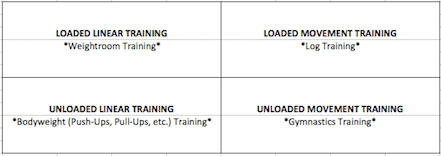
I am a huge proponent of gymnastics training, but we can save that for another day. A further dive into using The Log shows you some of the benefits of training in the top right of the quadrants above:
Whole Body Integrated Movement
-Intermittent Variable Activity vs. Specific Muscle Groups and Force Isolation
-Benefits (of Whole Body Integration):
-Spread force throughout the body (Muscles, fascia, skin, joints, nervous system)
-Energy efficiency (Minimize wear and tear on joints)
-Train movements not muscles
-Vector variability
-Whole is greater than the sum of its parts
Vector Variability
-Force application through multiple angles (Multiple positions + Planes of motion)
-Minimize pattern overload
-Enhance “motor vocabulary” and neuroplasticity
-Intra- and intermuscular coordination
Leverage
-Increase weight and force in movements by moving The Log away from the body in different planes of motion
Rhythm and Timing
-No critical delays (no guarding or catching) means you’re stable, mobile, and have motor control
-Having good rhythm and timing usually means having good form
Momentum-Based Training
-Capture energy through momentum-based training
Odd Position Strength
-Ability to generate force from a VARIETY of postures while maintaining integrity
-Ability to maintain strength while in less than ideal positions
-Promotes “Motor Intelligence” (ability to adapt or learn motor skills under different circumstances or challenges)
Metabolic Influence
-Adding load to movement will increase intensity (and thus metabolic demand)
These points make the case for training with The Log incredibly tempting. They can be beneficial to everyone, but the above list sounds a lot like sport to me (making this style of training have a ton of potential benefit for athletes). As I said before, this should not replace the weightroom, but rather supplement it. You can use The Log in your warm-ups, as a metabolic circuit, or give it it’s own training day. I typically use it on my “non-lift” days (meaning Wednesday and/or Saturday in my current four-day split). Below are some videos to give you an example of some exercises you can do with the log (you will also find more on Instagram – @chrismess_asp)
Rotational Lunge with Lift
Low to High Rotational Lift
Forward Lunge with Twist
 All Star Performance
Leave a comment